


Scott Fcasni
If you have searched for suppressor age requirements, you have probably seen conflicting answers. Some sources say you must be 21 to own a suppressor, while others say federal law does not set a minimum age for possessing an NFA firearm. The confusion comes from treating buying, possessing, transferring, and making an NFA item as if they were the same legal situation. They are not. Under current ATF guidance, the National Firearms Act (NFA) does not establish a minimum age for possession of an NFA firearm, while federal firearms law restricts what a licensed dealer can sell or deliver to an individual under 21 when the firearm is other than a rifle or shotgun. Because suppressors are classified as NFA firearms, the age question depends on the transaction and the laws that apply to it.
This article is for general informational purposes and does not constitute legal advice. Consult a qualified firearms attorney or your licensed dealer for guidance on your specific situation. This article specifically covers federal and Florida suppressor laws, which vary significantly by state, and some states prohibit civilian suppressor ownership entirely.
Is There a Separate Age Requirement for Suppressors?
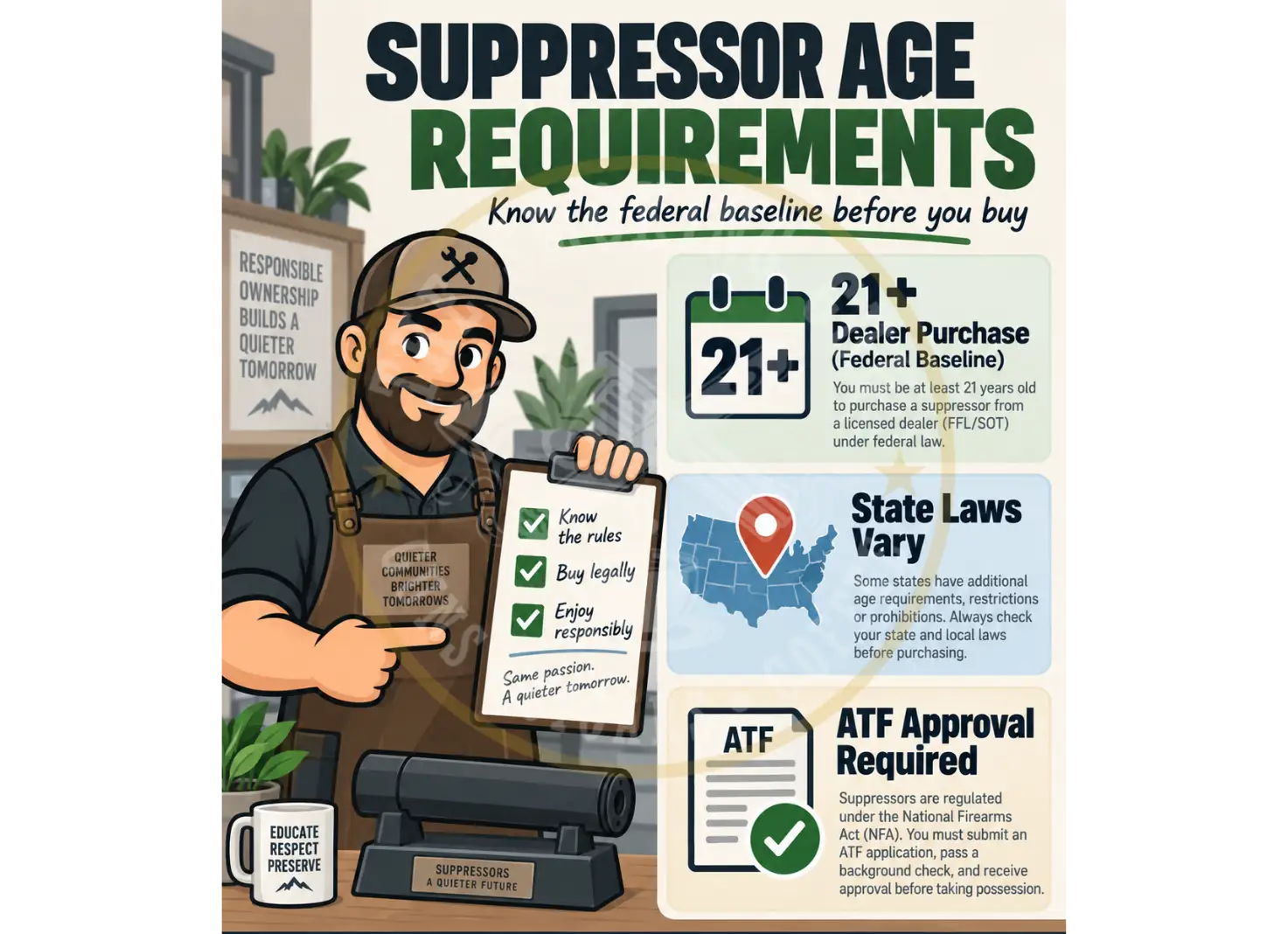
There is no single federal NFA age that answers every suppressor question. A suppressor, also called a silencer, is regulated as an NFA firearm, but the NFA itself does not state that a person must be 21 to possess one. The 21-year threshold commonly associated with suppressors comes from federal rules governing licensed dealers, rather than from a blanket NFA possession rule. That distinction is important because someone asking whether they can buy a suppressor is asking a different question from someone asking about possession under a particular lawful circumstance.
What the NFA Says About Age
The National Firearms Act regulates certain firearms, including silencers, through federal registration and transfer requirements. ATF’s current guidance states that the NFA contains no minimum age requirement for possession of NFA firearms. This does not mean that every person of any age can legally possess a suppressor. Other federal firearm restrictions and state laws can still apply, and a person’s legal eligibility matters separately from the NFA’s age language.
Where the 21-Year Rule Comes From
The 21-year figure comes from federal restrictions on licensed firearms dealers. Under 27 CFR § 478.99(b), a licensee generally cannot sell or deliver a firearm other than a rifle or shotgun to an individual the licensee knows or has reasonable cause to believe is under 21. ATF repeats this distinction in its current firearms Q&A. This is why an individual purchasing a suppressor through a licensed dealer will generally encounter a 21-year federal age requirement for that dealer transaction.
Why 21 to Own a Suppressor Is an Oversimplification
Saying you have to be 21 to own a suppressor leaves out the distinction between dealer sales and possession. A more accurate statement is that 21 is the key federal age threshold for an individual receiving the relevant firearm from a licensed dealer, while the NFA itself does not establish a minimum possession age. The person’s eligibility, the type of transaction, and state law must still be considered before determining whether a particular transfer or possession is lawful.
How Old to Buy a Suppressor From a Licensed Dealer?
For someone purchasing a suppressor from a licensed firearms dealer, the federal dealer-age rule is the most important starting point. Federal regulations prohibit a licensed dealer from selling or delivering a firearm other than a rifle or shotgun to an individual whom the dealer knows or has reasonable cause to believe is under 21. Since ATF classifies a silencer as an NFA firearm, a suppressor purchase through a licensed dealer generally falls under the 21-year dealer restriction.
Why 21 Is the Relevant Age for a Dealer Sale
The important point is that the dealer rule governs the licensee’s sale or delivery. It is different from saying that the NFA creates a universal 21-year possession requirement. This distinction explains why online articles can appear to disagree while discussing different parts of federal firearm law. For a customer purchasing a suppressor through a licensed dealer, however, the 21-year federal dealer restriction is directly relevant.
Does an ATF Form 4 Have Its Own Age Requirement?
ATF Form 4 is the application used to request approval to transfer and register an NFA firearm. It is part of the federal NFA transfer process, but it should not be treated as establishing a standalone universal age rule for all types of NFA possession. The applicable age question must be considered together with the underlying federal firearm rules, the type of transfer, and state law.
Does Buying a Suppressor Online Change the Age Rule?
Buying a suppressor online does not create a separate federal age category. An online order does not allow a purchaser to bypass the requirements that apply to the lawful transfer of the NFA firearm. If the transaction involves a licensed dealer, the dealer must still comply with applicable federal requirements before the suppressor can be transferred to the customer.
Is 18 the Minimum Age to Possess an NFA Firearm?
No. It would be inaccurate to describe 18 as the universal federal minimum age for possessing an NFA firearm. ATF’s current guidance expressly states that the NFA contains no minimum age requirement for possession of NFA firearms. That does not establish a general right for an 18-year-old, or anyone else, to possess a suppressor in every circumstance. Federal firearm restrictions, state law, and the particular transfer or ownership arrangement can affect the result.
Possession Is Different From Purchasing
A person can encounter different legal rules depending on whether they are purchasing an NFA firearm from a dealer, receiving it through another lawful transfer, or possessing an item that is already lawfully registered. The dealer-sale restriction and the NFA possession rule should therefore not be combined into a single age statement. This is one of the most important distinctions to keep in mind when researching suppressor age requirements.
Why an 18-Year-Old Cannot Simply Assume They Are Eligible
The absence of a minimum age in the NFA does not mean that being 18 automatically makes someone eligible to receive or possess a suppressor. Other federal firearm restrictions can apply, and states can impose their own requirements. The legal status of the individual, the transaction, and the firearm all matter. For that reason, claims that 18 is the suppressor age are just as misleading as claims that 21 is the NFA possession age.
Why Private Transfers Need Separate Legal Analysis
A private NFA transfer is not simply the same thing as a dealer sale conducted without a dealer. NFA firearms are subject to federal transfer and registration requirements, and state law can add additional restrictions. Anyone considering a private transfer should confirm that the specific transaction is lawful rather than relying on a general age number found online.
Does the Way You Acquire the Suppressor Affect the Age Question?
Yes. The legal framework can differ depending on how the suppressor is being acquired or possessed. A purchase from a licensed dealer, a private NFA transfer, an application to make an NFA firearm, and ownership through a trust or other legal entity are different circumstances. The table below provides a high-level comparison without treating any one route as an automatic exception to federal or state firearm law.
| Situation | Main point |
| Purchase from a licensed dealer | Federal dealer age restrictions apply |
| Private NFA transfer | Separate NFA transfer requirements and state laws apply |
| Making an NFA firearm | Uses a different ATF application and legal framework |
| Trust or legal entity | The entity structure does not automatically remove individual eligibility requirements |
| Inheritance | NFA estate-transfer rules can apply and differ from an ordinary purchase |
Buying From an FFL/SOT
An FFL is a Federal Firearms Licensee. Some dealers involved in NFA transactions also have the appropriate Special Occupational Tax status. For an individual purchasing a suppressor from a licensed dealer, the federal 21-year dealer restriction is a central requirement. The transaction must also comply with applicable NFA rules and any state requirements.
Transferring Between Private Parties
A private-party NFA transfer still falls under federal NFA requirements. It should not be presented as a simple method for avoiding the dealer age rule or other firearm restrictions. The legality of a private transfer can depend on the people and states involved, the registered status of the NFA firearm, and the transfer requirements in effect at the time.
Making an NFA Firearm With Form 1
Form 1 has a different purpose from Form 4. ATF identifies Form 1 as the Application to Make and Register a Firearm, while Form 4 is used to request approval to transfer and register an NFA firearm. Because these applications concern different legal actions, the age question should not be reduced to Form 1 means 18 and Form 4 means 21. The applicable federal and state rules still need to be considered.
Acquiring Through a Trust or Legal Entity
A trust or legal entity can own an NFA firearm, but creating one does not erase federal firearm eligibility requirements. ATF requires responsible persons associated with a trust or legal entity to provide the information and background-check materials required for applicable NFA applications. The important question is whether a person actually qualifies as a responsible person under the applicable rules, rather than simply whether their name appears somewhere in a trust document.
What Other Requirements Apply Besides Age?
Age is only one part of the legal analysis. A person can meet an age threshold and still be prohibited from possessing firearms or from completing a particular NFA transaction. Federal firearm eligibility, state law, the type of transaction, and the status of the NFA firearm all need to be considered before a transfer takes place.
Prohibited-Person Restrictions
Federal law prohibits certain people from possessing firearms. These restrictions can involve circumstances such as qualifying felony convictions, fugitive status, unlawful use or addiction to controlled substances, certain mental-health-related adjudications or commitments, qualifying domestic-violence restrictions or convictions, and other categories established by federal law. Age does not override a separate prohibition.
State of Residence and State Law
Federal approval is only part of the picture. ATF explains that an NFA application cannot be approved when federal, state, or local law prohibits the making or possession of the firearm. This makes the buyer’s state of residence and the laws applicable there important parts of the process.
NFA Registration and ATF Approval
Suppressors are NFA firearms, so their transfer or making is subject to the federal NFA framework. ATF identifies Form 4 as the application used to request approval to transfer and register an NFA firearm and Form 1 as the application to make and register one. These are federal registration processes, not optional paperwork that can be skipped because a person meets an age requirement.
Background Checks for Applicable Applicants and Responsible Persons
Background checks are another part of the federal NFA process. For trusts and legal entities, ATF’s current 41F guidance requires the applicable responsible persons to complete the required questionnaire and undergo the specified background check when the trust or entity applies to make or receive an NFA firearm.
What Are the Current Suppressor Rules in Florida?
For Florida residents, the federal age distinction still matters, but Florida law should be considered separately. A person should not assume that a general statement about federal suppressor law answers every question about a Florida transaction. The Smoking Gun serves customers in the Davie and Hollywood areas, making Florida-specific information especially useful for readers researching suppressor purchases locally.
Are Suppressors Legal in Florida?
Suppressors are legal under federal law only when the applicable NFA requirements are satisfied, and state law must also permit the relevant possession or transaction. Florida is among the states where civilian suppressor ownership is permitted, but that does not remove federal requirements or make every possible suppressor transaction lawful.
Does Florida Have a Separate Suppressor Age Rule?
Florida firearm laws should not be reduced to a single 18 or 21 answer for every suppressor situation. The federal dealer rule remains relevant to purchases from licensed dealers, while the specific circumstances of possession or other types of transfers can raise different questions. Anyone planning an NFA transaction in Florida should confirm the current federal and state requirements that apply to that transaction.
Did the 2026 NFA Tax Change the Suppressor Age Requirement?
Changes to NFA taxation do not, by themselves, create a new age rule. The age question and the tax question are separate parts of the federal framework. Current ATF materials should be checked for the applicable transfer or making tax because NFA tax rules can change, but a change in the amount of a tax does not automatically eliminate the underlying transfer, registration, eligibility, or age requirements.
What Is the Difference Between Form 4 and Form 1 for Suppressors?
Form 4 and Form 1 are often mentioned together in suppressor discussions, but they serve different purposes. Understanding that difference helps prevent another common age-related misconception.
Form 4 Is Used for an NFA Transfer
ATF Form 4 is the application used to request approval to transfer and register an NFA firearm. It applies when an NFA firearm is being transferred to a new registered owner or transferee under the applicable federal process. The form itself does not create one universal age rule for every NFA circumstance.
Form 1 Is Used to Apply to Make an NFA Firearm
ATF Form 1 is the application to make and register an NFA firearm. It is therefore different from Form 4, which concerns transfer and registration. The fact that the applications serve different purposes does not mean a person should assume a particular age automatically makes a Form 1 application lawful. Other federal and state requirements still apply.
Why the Form You Use Does Not Create a Universal 18 vs. 21 Rule
The age question must be tied to the actual legal circumstance. Federal dealer restrictions, NFA requirements, state law, and the person’s eligibility can all matter. Treating Form 1 as an automatic 18-year-old route or Form 4 as an automatic 21-year-old rule leaves out too much of the law to be a reliable answer.
What Should You Check Before Buying or Transferring a Suppressor?
Before starting an NFA transaction, the safest approach is to identify the exact type of transaction instead of relying on a single age number from a general internet article. A buyer should confirm the applicable federal requirements, state law, eligibility rules, and dealer procedures before assuming a suppressor can be transferred.
- Confirm Your Age and Federal Eligibility
- Confirm That Suppressor Ownership Is Legal Where You Live
- Identify the Type of NFA Transaction
- Confirm Which ATF Form Applies
- Ask the FFL/SOT About Its Current Transfer Process
When Should You Speak With an FFL/SOT or Firearms Attorney?
A licensed NFA dealer can explain its own transfer process and help identify the paperwork and transaction requirements it handles. A firearms attorney may be more appropriate for unusual questions involving state-law restrictions, trusts, estate planning, disputed eligibility, or a private NFA transfer. Getting the right type of guidance is especially important when a simple age question turns out to involve several separate legal rules.
When Federal and State Rules Appear to Conflict
If federal guidance and a state requirement appear to point in different directions, do not assume the federal rule automatically settles the matter. The transaction must comply with applicable law at every level.
When a Trust or Legal Entity Is Involved
Trusts and corporations can raise additional questions about responsible persons, control, possession, and eligibility. ATF’s current rules specifically address responsible persons connected with trusts and legal entities.
When a Private NFA Transfer Is Being Considered
Private NFA transfers involve more than simply handing an NFA firearm from one person to another. Federal transfer and registration requirements still apply, and state law must also be considered.
When Your Eligibility Is Unclear
If you are unsure whether your age, legal status, state of residence, or another factor affects your eligibility, get the question resolved before attempting the transaction. A dealer can explain its process, while a qualified attorney can address legal questions that require individualized advice.