

Scott Fcasni
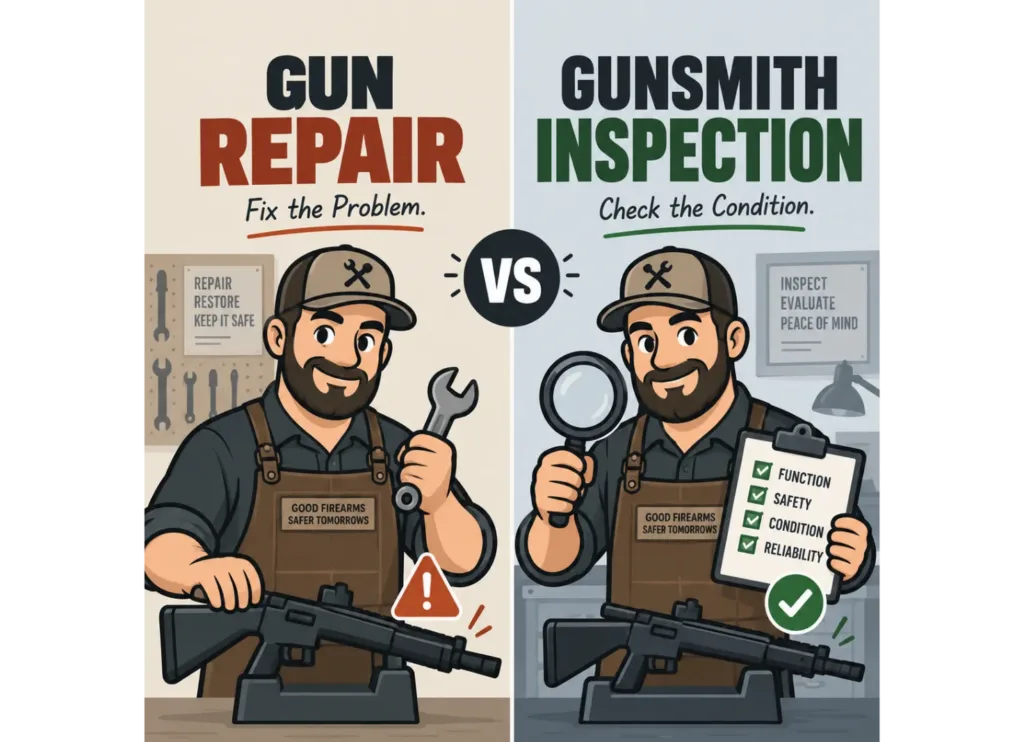
A gunsmith inspection is a professional assessment of a firearm’s condition. It can help identify visible damage, excessive wear, corrosion, mechanical concerns, or other issues that may not be obvious to an owner. An inspection does not automatically mean that a repair is needed. The result may be that the firearm requires routine maintenance, further evaluation, repair, or no corrective work at all.
Gun repair has a different purpose. It addresses a specific problem that affects the firearm’s condition or function. Depending on the diagnosis, repair work may involve replacing a damaged component or correcting a mechanical issue. The appropriate work depends on the firearm, the problem found, and the qualifications and equipment of the gunsmith.
Routine firearm maintenance is separate from both. Cleaning and ordinary owner upkeep help maintain a firearm, but they do not replace a professional evaluation when there is unexplained damage, abnormal function, an unknown history, or a question about whether the firearm is appropriate to use.
| Situation | Inspection | Repair |
| Used firearm with unknown history | Yes | If a problem is found |
| Inherited firearm | Often appropriate | If an issue is identified |
| Older firearm stored for years | Often appropriate | If repair is needed |
| Persistent malfunction | Yes, for diagnosis | Often |
| Visible damage or serious corrosion | Yes | May be required |
| Routine cleaning | Usually not | No |
| Known broken or damaged component | May precede repair | Yes |
The simplest way to think about it is this: an inspection answers “What condition is this firearm in?” while repair answers “How should this identified problem be corrected?”
When Should You Have a Firearm Professionally Inspected?
A professional inspection makes sense when you have a reason to question a firearm’s condition, even if it has not completely stopped functioning. The strongest triggers are an unknown history, significant age, long-term storage, visible condition concerns, previous modifications, or a change in normal operation. A gunsmith can assess the firearm as a whole rather than focusing on one symptom in isolation.
Before Using a Newly Acquired Used or Surplus Firearm
A secondhand or surplus firearm may have a history that the new owner cannot fully verify. Previous maintenance, storage conditions, repairs, modifications, and general wear may all be unclear. A firearm can also look acceptable externally while having condition issues that require professional attention.
For that reason, a professional inspection is a sensible consideration before putting an unfamiliar used firearm back into regular use. The purpose is not to assume that every used firearm is defective. It is to establish its condition based on professional assessment rather than relying only on appearance or a seller’s description.
When You Inherit a Firearm
Inherited firearms often come without a complete maintenance record. A family member may have owned the firearm for many years, stored it for an extended period, or had work performed that the next owner does not know about.
An inspection can help establish its current condition and identify concerns related to age, corrosion, wear, previous work, or other changes. This is particularly important if the firearm has been sitting unused and its history is incomplete.
When an Older or Antique Firearm Has Been Stored for Years
Age by itself does not prove that a firearm is unsafe or requires repair. Older firearms can, however, have different materials, designs, repair histories, and storage conditions from newer examples. Antique and historical firearms may also have been modified or reconfigured during their service life.
A professional assessment is therefore more useful than assuming that an older firearm is suitable for range use simply because it looks intact. A qualified gunsmith can determine whether its current condition calls for additional attention.
After Extended Storage
A firearm that has spent a long period in storage may have accumulated corrosion, deterioration, or other condition issues. The storage environment matters as well. Humidity, temperature changes, poor protection, and neglect can affect the firearm over time.
There is no universal rule that every firearm stored for a particular number of months automatically requires repair. However, a firearm that has been unused for a year or longer, particularly one with an unknown storage history, is a reasonable candidate for professional evaluation before returning to regular use.
For Frequently Used Carry or Duty Firearms
Frequent use places different demands on a firearm than occasional recreational use. Regular range handling, carry, environmental exposure, and repeated operation can contribute to wear over time. Rather than treating six or twelve months as a mandatory inspection interval for every firearm, owners should consider frequency of use, manufacturer guidance, storage conditions, maintenance history, and any change in normal operation. A professional inspection can be especially useful when a heavily used firearm begins to show wear or behaves differently from before.
What Does a Gunsmith Check During a Firearm Inspection?
A professional firearm inspection is broader than simply looking for dirt or surface rust. A qualified gunsmith considers the firearm’s overall condition and looks for signs that could affect function, durability, or safe operation. The exact inspection process varies according to the firearm and the reason it was brought in.
Overall Physical Condition
The gunsmith can assess visible wear, corrosion, damage, and the condition of relevant components. Significant rust, deep pitting, cracks, or other unusual damage deserve more attention than ordinary cosmetic marks. The location and severity of a condition matter. A small cosmetic blemish is different from damage affecting a critical area, which is why owners should avoid deciding that a concerning mark is harmless based on appearance alone.
Chamber and Bore Condition
The chamber and bore are important parts of a firearm’s overall condition. A professional inspection can identify concerns such as corrosion, damage, or a possible obstruction and determine whether additional examination is necessary. An owner who is uncertain about the condition of a bore or chamber should not rely on guesswork. If there is a suspected obstruction or damage that cannot be confidently assessed, professional evaluation is the safer choice.
Mechanical and Safety-Critical Components
A gunsmith can evaluate relevant operating and safety-related components for signs of abnormal wear, damage, looseness, or improper function. This may include concerns involving controls, the trigger system, and other components that are important to the firearm’s operation. These areas are particularly unsuitable for trial-and-error repair because a problem may involve more than the component that first appears to be at fault.
Headspace and Chamber Concerns
Headspace is a technical aspect of firearm condition that may require specialized measurement and professional equipment. It becomes particularly relevant when there is an uncertain history of previous barrel or chamber work or other circumstances that raise questions about the firearm’s configuration. Owners should not assume that a chamber is correctly configured simply because the firearm appears complete or has familiar markings. When headspace or chamber dimensions are in question, the appropriate response is professional evaluation using suitable equipment.
Signs of Previous Modification or Improper Work
A firearm may have been altered by a previous owner or service provider. Modifications involving triggers, controls, or other mechanical components can change how a firearm operates. If the history of a modification is unknown or the work appears questionable, a gunsmith can assess the condition and determine whether additional service is warranted. This is especially important when an owner cannot establish what was changed or who performed the work.
Structural Condition and Metal Fatigue
Cracks, significant corrosion, deep pitting, and other structural concerns require more attention than ordinary surface wear. Metal fatigue can also be difficult to identify reliably from appearance alone. A professional inspection can help distinguish normal wear from a condition that deserves further investigation. If there is visible cracking, serious corrosion, or other structural damage, the firearm should not be treated as a normal maintenance issue.
How do you know if a firearm needs a professional repair?
Repair becomes the appropriate focus when there is a known or persistent problem that requires corrective work. In many cases, an inspection or diagnosis comes first because the visible symptom does not always identify the underlying cause.
Persistent Malfunctions
Repeated failures to feed, extract, eject, or otherwise function as expected are reasons to seek professional diagnosis, particularly when the problem continues after appropriate routine maintenance. A recurring malfunction should not be treated as something to ignore simply because the firearm occasionally operates normally. Intermittent problems can still indicate a mechanical issue that needs professional assessment.
Controls That Feel Loose, Sluggish, or Abnormal
A noticeable change in the way a trigger, safety, slide, action, or other control operates can indicate a condition that deserves professional attention. Changes such as unusual looseness, sluggish movement, inconsistent operation, or a control that does not behave as expected should not be dismissed as normal wear without assessment.
Visible Damage to Critical Components
Cracked components, significant corrosion, deep pitting, or suspected structural damage can move the situation beyond routine maintenance. Damage affecting important firearm components should be professionally evaluated before further use.
A Mechanical Problem Has Already Been Identified
If a qualified professional has identified a broken, damaged, or worn component, the next step is corrective service rather than simply repeating an inspection. The repair should be based on the actual diagnosis and the firearm’s specific requirements.
The Same Problem Keeps Returning
A problem that repeatedly returns after cleaning or previous attention deserves a closer diagnosis. Repeatedly attempting different fixes without establishing the cause can waste money and may leave the underlying issue unresolved.
Firearm Warning Signs That Should Not Be Ignored
Some signs deserve immediate professional attention because they indicate that the firearm’s condition may be different from normal. The important point is not to diagnose the exact fault yourself, but to recognize when continued use is a poor choice.
Unusual Function or Behavior
Unexpected sounds, unusual feel, changes in operation, repeated malfunctions, or controls that suddenly behave differently are all reasons to stop and assess the situation professionally.
Visible Cracking or Significant Corrosion
Deep rust, substantial pitting, visible cracks, or other structural damage should not be treated as ordinary cosmetic wear. The severity and location of the damage can affect its significance.
Evidence of Previous Alteration
Unknown trigger work, unexplained modifications, or other alterations can create questions about the firearm’s current condition. If you do not know what was changed or whether the work was performed correctly, a gunsmith should evaluate it.
Uncertainty About Whether the Firearm Is Safe to Use
Uncertainty itself is a valid reason to seek professional help. If you cannot confidently determine whether a firearm is in appropriate condition, guessing is unnecessary. A qualified gunsmith can assess the firearm and explain whether further service is required.
Can You Handle Firearm Maintenance Yourself, or Do You Need a Gunsmith?
Routine maintenance and professional gunsmithing serve different purposes. Owners can follow the firearm manufacturer’s instructions for appropriate cleaning and routine care, but those tasks should not be confused with diagnosing mechanical or structural problems.
Routine Owner Maintenance
Basic maintenance can help keep a firearm in proper condition between professional service visits. Manufacturer instructions should guide the type of cleaning, maintenance, storage, and disassembly appropriate for a particular firearm. Normal signs such as light fouling, minor handling marks, dust, or ordinary cosmetic wear do not automatically mean that a firearm needs repair.
Situations Better Left to a Gunsmith
Professional help is the better choice when a problem involves specialized measurement, safety-critical components, unknown internal assembly, structural damage, suspected modification, or a persistent malfunction. This is particularly important when the work requires specialized gauges, presses, fitting equipment, or knowledge of how safety-critical components interact. A firearm that has been incorrectly assembled or modified can present risks that are not obvious from the outside.
Why Guesswork Is a Poor Substitute for Professional Diagnosis
Internet advice can help explain general concepts, but it cannot replace an in-person assessment of a specific firearm. Two firearms showing a similar symptom may have different causes, and an owner may not have the equipment needed to distinguish them. If the issue involves the firearm’s safety, structural condition, or reliable operation, professional diagnosis is a better approach than repeatedly changing parts or attempting unfamiliar repairs.
Does Your Firearm Need an Inspection or a Repair?
The right service depends on what you know about the firearm and what has happened to it.
| What is happening? | Best next step |
| You bought a used firearm with an unknown history | Professional inspection |
| You inherited an older firearm | Professional inspection |
| The firearm has been stored for years | Consider professional inspection before regular use |
| You notice unusual operation | Stop using it and seek professional evaluation |
| It repeatedly malfunctions | Gunsmith diagnosis and possible repair |
| There is visible structural damage or serious corrosion | Professional evaluation before use |
| A specific component has failed | Repair evaluation |
| You need routine cleaning and maintenance | Follow the manufacturer’s maintenance guidance |
| You are unsure whether the firearm is appropriate to use | Seek professional assessment rather than guessing |
The important distinction is that inspection is usually the starting point when the condition is uncertain, while repair is appropriate when a specific problem has been diagnosed.
How often should a carry gun or hunting rifle be inspected?
There is no single inspection schedule that fits every firearm. A rarely used firearm stored under suitable conditions has different service needs from a firearm that is carried or used frequently.
Consider these factors when deciding whether a professional inspection is due:
- Frequency and type of use
- Age and overall condition
- Storage environment
- Maintenance history
- Previous repairs or modifications
- Changes in normal operation
- Manufacturer recommendations
- Professional recommendations based on the firearm’s condition
A six- or twelve-month interval can be a reasonable consideration for some heavily used firearms, but it should not be presented as a universal requirement. A firearm with a new safety concern or mechanical problem needs attention regardless of when its last inspection took place.
Firearm Service and ATF/FFL Considerations
Federal rules can affect how a licensed gunsmith handles a firearm that is left at the shop. ATF guidance states that when a firearm is brought to a licensed gunsmith for adjustment or repair and the owner waits while the work is performed, or the firearm is returned to the owner during the same business day, it generally does not have to be entered as an acquisition in the gunsmith’s acquisition and disposition record. If the gunsmith retains the firearm from one business day to another or longer, the firearm must be recorded in the required A&D record.
ATF also states that a person conducting the business of repairing, customizing, refinishing, or engraving firearms is considered a gunsmith within the federal licensing framework. Specific circumstances can create additional requirements, so customers should confirm current procedures with the licensed shop and consult current ATF guidance for federal requirements. Firearm laws and procedures can change, and federal rules do not replace state or local requirements. This information is general in nature and is not legal advice.
Federal Intake Compliance Note (ATF Policy): When bringing a firearm to a licensed FFL gunsmith for immediate same-day evaluation or adjustment, it generally does not require formal entry into the shop’s acquisition and disposition (A&D) records. However, multi-day repairs or overnight storage require official logging under federal law.
Choosing a Gunsmith for Inspection or Repair
The right gunsmith should be able to explain what service is appropriate for the problem rather than treating every concern as a repair job. Look for relevant experience, clear service procedures, appropriate licensing, and a willingness to explain what was found during an inspection. For firearm owners in Hollywood, Davie, and the surrounding South Florida area, The Smoking Gun offers gunsmithing services that include routine repairs and professional cleaning.
If you have a used, inherited, older, frequently used, or unfamiliar firearm and are unsure whether it needs cleaning, inspection, or repair, discussing the firearm with a professional gunsmith is a practical first step. The Smoking Gun’s gunsmithing team can help determine which service is appropriate based on the condition and issue being presented.